
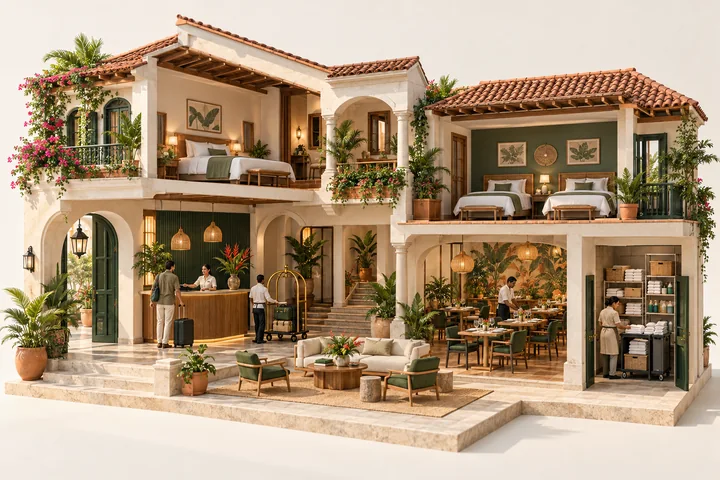
What it is
A hotel PMS is the operational record for reservations, room allocation, guest accounts and room status. The broader hotel software stack may add distribution, a booking engine, payment processing, restaurant point of sale, revenue management and guest communication. These are related products, not interchangeable labels. A channel manager alone should not be assessed as a complete hotel PMS. Nor does a digital registration form establish that reception, finance and housekeeping can manage an interrupted stay. For a Colombian hotel, evaluate local guest-reporting and invoicing arrangements alongside front-desk needs. A small inn may value simple daily execution; a hotel with group business needs to demonstrate deposits, room blocks, billing instructions and departmental charges. Compare products against those concrete requirements before choosing the largest feature list.
Understand the market
Colombian operational fit
Sixto and LobbyPMS warrant an early look for different local operating profiles. Sixto emphasizes connected lodging operations; LobbyPMS documents hotel reception and local workflows. Compare scope using actual hotel requirements and exceptions.
Independent-hotel platforms
Cloudbeds, Mews, Stayntouch and RoomRaccoon offer distinct combinations of operations, distribution, mobility and integrations. Their inclusion is not evidence of identical Colombian readiness. Select the package and local implementation together.
Different ends of hotel complexity
Little Hotelier explicitly targets smaller properties; OPERA Cloud merits evaluation for departmental and group requirements. This contrast is about workflow and implementation scope, not a claim that room count alone determines the right product.
Summary table
Scroll the table horizontally to compare all criteria. Each product links to its detailed assessment below.
| Product | Best fit | Product type / category strength | Colombia / integration fit | What to verify | Official source |
|---|---|---|---|---|---|
| Sixto | Colombian apartment-style and focused-service lodging | Connected hospitality operations | Documented local workflows; configured invoicing | Group, POS and hotel-finance scope | Sixto |
| Oracle OPERA Cloud | Hotels with groups, departments or complex billing | Hotel PMS for complex operational requirements | Colombian configuration requires confirmation | Implementation, interfaces and regional payments | Oracle OPERA Cloud |
| Cloudbeds | Independent hotels seeking a connected suite | Hospitality platform with distribution | Documented Colombian partner integrations | Package, partner fees and reconciliation | Cloudbeds |
| Mews | Hotels combining digital service and hybrid inventory | Cloud hotel PMS and integration ecosystem | Colombian workflows require confirmation | Payments, accounting and operational fit | Mews |
| Stayntouch | Hotels prioritizing mobile staff service | Hotel PMS with mobile reception | Colombian workflows require confirmation | Devices, local partners and fallback | Stayntouch |
| Little Hotelier | Small hotels, inns and owner-run accommodation | Small-property PMS and distribution tools | Colombian workflows require confirmation | Plan scope and complex-case coverage | Little Hotelier |
| RoomRaccoon | Independent hotels wanting a packaged suite | Hotel PMS, booking engine and channels | Colombian workflows require confirmation | Upgrade scope, payments and local reporting | RoomRaccoon |
| LobbyPMS | Colombian hotels wanting local workflows in the PMS | Hotel PMS with Colombian functionality | Documented native SIRE/TRA; provider invoicing | Group billing, POS scope and exceptions | LobbyPMS |
How we evaluated the options
- Front desk: create, amend, move and cancel a reservation, with clear room status and controlled permissions.
- Finance: test deposits, separate payers, refunds, company balances and corrections after departure.
- Housekeeping: distinguish dirty, clean, inspected and unavailable rooms, and follow maintenance back to availability.
- Commercial operations: verify the required channels, rate plans, restrictions and direct-booking journey.
- Hotel complexity: demonstrate groups, restaurant charges and multi-property reporting when your business needs them.
- Colombian implementation: identify the native or partner route for SIRE, TRA, invoicing and locally supported payments.
We verified documented product scope and identified explicit Colombian integration evidence. We did not verify live credentials, individual contracts, bank settlement, filing acceptance or service levels. A missing claim is an open question, not proof that a feature is unavailable.
Sixto: a shared operating record for Colombian lodging teams
Best for: Colombian apartment-style and focused-service lodging
Sixto is our first recommendation to evaluate when the property runs like an aparthotel or a focused lodging operation and the central problem is fragmented daily work. Reservations, guest conversations, information collection and team tasks share an operating context. SIRE/TRA workflows and configured electronic invoicing support the Colombian side of the stay, with permissions and activation prerequisites. Run a reception-to-operations handoff in the demonstration: an arrival changes, a guest is missing information and the assigned unit needs attention. The value to assess is whether the team can identify and resolve the next action from the same record.
Do not assume enterprise hotel parity. Group blocks, banquet billing, restaurant point-of-sale interfaces, loyalty and advanced night-audit requirements need explicit verification. For a hotel that depends on those capabilities, compare dedicated hotel platforms as well. Sixto’s position first is our publisher recommendation for an appropriate operating profile. [1]
Oracle OPERA Cloud: departmental and group complexity
Best for: Hotels with groups, departments or complex billing
OPERA Cloud is a substantive hotel PMS candidate when group business, company accounts and departmental operations shape the requirements. Oracle documents group blocks, split billing and housekeeping workflows, alongside company profiles and links to its point-of-sale ecosystem. The evaluation should begin with the hotel’s most complex ordinary day: a group arrives, rooming assignments change, restaurant charges post and billing instructions divide costs. This is a different purchasing exercise from choosing a lightweight booking calendar. Ask the implementation team to show the proposed modules working together and explain which processes depend on additional interfaces or services.
Treat implementation as a defined project with named owners for data, finance, interfaces and staff training. Confirm the Colombian configuration and each payment service separately. Do not infer regional availability from an international product page, or assume every OPERA product and module is included in one PMS quote. [2] [3]
Cloudbeds: operations and distribution in a broad suite
Best for: Independent hotels seeking a connected suite
Cloudbeds is relevant when a hotel wants property operations, distribution and guest-facing tools under a broader platform. Its PMS page emphasizes connected commercial and operational work and supports multi-property management. For an independent hotel, this creates a useful comparison with products that require more separate applications. Evaluate the package against a normal revenue day: change a rate, receive a booking, prepare the room, take a payment and inspect the resulting reports. Then include an exception, such as a room going out of service after a reservation was made. Integration breadth matters only if the handoffs remain understandable.
Cloudbeds officially documents Colombian partner solutions for guest reporting and invoicing. Verify the selected partner, contractual scope and responsibility when a correction fails. Ask reception and finance to demonstrate the same transaction across the proposed systems, rather than reviewing the PMS and partner in separate sales presentations. [4] [5]
Mews: modern hotel workflows and hybrid accommodation
Best for: Hotels combining digital service and hybrid inventory
Mews offers a cloud hotel PMS and an integration ecosystem, with a separate documented proposition for serviced apartments and flexible stays. That makes it worth evaluating for hotels blending conventional rooms with apartments or a more digital guest journey. Avoid deciding on interface appearance alone. Ask staff to handle a guest whose arrival is early, room is not ready and bill will be paid partly by a company. Follow the exception until the room is released and the account is settled. The purpose is to assess how its operational model fits your team’s responsibilities.
Confirm the exact payment, accounting and Colombian reporting configuration. If the hotel depends on a restaurant system or established group workflow, demonstrate those interfaces too. A modern PMS can be attractive while still requiring implementation work around local partners, staff training and data migration. [6] [7]
Stayntouch: mobile reception without dropping hotel controls
Best for: Hotels prioritizing mobile staff service
Stayntouch deserves attention when the hotel wants staff to serve guests away from a fixed reception desk. It documents mobile hotel workflows together with group handling, financial controls and integration options. This combination makes it relevant to an independent or boutique hotel that needs more than a contactless arrival form. Take the proposed device into a realistic demonstration: find a reservation, inspect room readiness, change the assignment and review charges. Also test how the team communicates a problem to housekeeping and how a supervisor identifies work that has not been completed.
Mobility should be evaluated alongside permissions, device management and fallback procedures. Confirm Colombian payment and reporting arrangements, the distribution setup and the scope of any guest messaging or key integration. Do not assume that a mobile interface removes the need for a carefully designed front-desk process. [8] [9]
Little Hotelier: a smaller-property operating toolkit
Best for: Small hotels, inns and owner-run accommodation
Little Hotelier explicitly addresses small properties, combining PMS capabilities with booking and distribution tools. It merits consideration when the operator wants to move from spreadsheets or separate extranets into a more manageable daily routine. The most informative test is a working morning: inspect departures, add a telephone booking, change a room and check what the next shift will see. Ask the intended users to repeat the tasks themselves. For a smaller hotel, the time and concentration required for routine work can matter more than a catalog of enterprise features that the property rarely uses.
Verify the chosen plan’s front-desk and team capabilities, required channels and Colombian reporting route. Regional payment availability also needs confirmation. If groups, restaurant posting or detailed company accounts are essential, demonstrate them before treating the small-property positioning as a complete match. [10]
RoomRaccoon: independent-hotel suite with selectable upgrades
Best for: Independent hotels wanting a packaged suite
RoomRaccoon combines PMS, booking engine and channel management for independent properties. Its product page distinguishes core tools from upgrades, including a more developed housekeeping offering. That makes it worth comparing when the hotel wants a consolidated system but needs to understand which operational modules are included. Start with room readiness and extras: a room has a maintenance issue, a guest requests an early arrival and reception adds a service. Follow what each user sees and which part of the proposed subscription handles the task. This is more revealing than comparing the suite’s headline description.
Ask for a written package breakdown, payment eligibility in Colombia and the named route for local reporting and invoicing. Distinguish the basic housekeeping list from the upgrade you may actually need. Verify integrations and document exports before assuming a consolidated suite covers every existing process. [11]
LobbyPMS: Colombian hotel reception and local workflows
Best for: Colombian hotels wanting local workflows in the PMS
LobbyPMS publishes a hotel-oriented product with reception, reservations, sales, payments and point-of-sale functions. Its Colombia materials explicitly describe SIRE and TRA workflows, and its invoicing page explains issuance through a technology provider. This makes it an important local comparison for a staffed hotel. The most useful demonstration follows a guest’s entire account, including an extra charge, a change in guest details and departure. Then examine the report or invoice result rather than stopping at the button that initiates it. A local feature name should correspond to an understandable process and evidence.
Check reporting triggers, property-specific configuration, rejected submissions and document corrections. Establish the scope of restaurant or retail operations and whether your group billing cases are covered. Published Colombian functionality is a meaningful strength; operational fit and supported failure recovery still need verification with your data model. [12] [13] [14]
Choose by operating model
Use the hotel’s operating model to select a short list. These situations are illustrative, not performance claims or customer examples.
A small independent hotel with a hands-on owner
The priority is replacing spreadsheets without making reception harder.
Compare Little Hotelier, LobbyPMS and Sixto, adding RoomRaccoon if its package matches the required scope. Give the owner and a receptionist the same morning workflow. Ask them to handle a phone reservation, a room that needs cleaning and an arrival missing guest details. Choose the option whose daily operation is understandable and whose Colombian reporting and invoicing route is concrete. A straightforward interface is useful, but it must still show incomplete work and preserve records when a payment, report or external connection needs attention.
- Create a phone booking and change its room.
- Block a room for maintenance.
- Recover a failed external action.
A boutique hotel redesigning the guest journey
Staff should greet guests around the property while maintaining financial control.
Compare Stayntouch and Mews with Cloudbeds. Decide which interactions should move onto a device and which still require a staffed process. Test an early arrival, a room not ready, an extra charge and a request that needs housekeeping. Then ask the next shift to explain the current state. Include Sixto when the property’s operating model is closer to an aparthotel and shared tasks matter most, but verify any hotel-specific billing or departmental interfaces. The winning design should reduce handoff ambiguity, not merely add a self-service screen.
- Use the intended mobile device.
- Change room assignment after arrival information is sent.
- Reconcile guest and company charges.
A hotel with groups and several revenue departments
Reservations include room blocks, split payers and charges from other systems.
Put OPERA Cloud on the shortlist and compare the relevant enterprise scope from other hotel platforms. Start with a written set of scenarios from sales, reception, housekeeping and finance. A demo should handle a changed rooming list, a deposit, a departmental charge and a billing correction. Require a clear module and interface proposal, with Colombian localization and support responsibilities named. This operating profile may justify a more involved project, but only if the implementation plan and training cover the actual workflows. Avoid choosing by brand recognition alone.
- Amend a group rooming list.
- Route departmental charges to the correct payer.
- Close and correct the group account.
A practical implementation sequence
Write the shift-based requirements
Ask reception, housekeeping and finance to describe a normal shift and the exceptions they cannot afford to miss. Include group sales and restaurant staff if relevant. Turn those situations into demo cases with expected outcomes. This prevents the procurement process from overvaluing features that look attractive but do not resolve the hotel’s actual work.
Design the financial and integration map
Identify the system responsible for room charges, extras, deposits, refunds and electronic invoices. List each interface and its support owner. Confirm who reconciles Colombian reports and what proof they receive. A diagram is useful only when it includes corrections and failures, not just the happy path between vendor logos.
Rehearse migration and a full operating day
Reconcile future reservations, guest balances, room inventory and user roles before switching. Run arrival, housekeeping handoff, departure and the hotel’s end-of-day process with staff from each shift. Keep historical records accessible. Agree who can halt the rollout and how the team works safely if an integration is temporarily unavailable.
Review after the first close
Compare system totals with actual receipts, invoices and departmental records. Review room-status discrepancies and unresolved integration actions. Confirm that night staff can investigate problems without the implementation consultant. Expand to other properties or additional modules only after the hotel can operate and reconcile the core workflow confidently.
What to include in the quote
Ask for a complete bill of materials: PMS, distribution, booking engine, payment processing, POS interfaces, guest tools, reporting partners, implementation and training. Specify rooms, properties, users and any group or enterprise modules. Hotel products often package these elements differently, so the same feature label can represent a different commercial scope.
Compare total effort over the contract term, including staff training, interface maintenance, local support and access to historical data after cancellation. Confirm settlement currency and Colombian payment availability, plus the cost of invoice or reporting partners. Avoid assuming that a global payment product is available in Colombia or that all services from one vendor share the same geographic coverage.
Demo checklist
Questions
What is the best hotel PMS in Colombia?
There is no useful universal answer. Sixto is our first option for an appropriate connected-lodging profile; LobbyPMS offers documented local hotel workflows; international platforms serve different operating models. Start with a full shift and your financial exceptions, then verify the Colombian configuration and complete commercial scope.
Is SiteMinder a hotel PMS?
A channel-management product should not automatically be compared as a complete PMS. Little Hotelier, powered by SiteMinder, explicitly combines small-property management and distribution tools. When evaluating any product, ask which system owns reservations, room status, guest accounts and end-of-day work.
Does every hotel need an enterprise system?
No. Group billing, departmental interfaces, chain requirements and financial controls matter more than prestige. A small hotel should still test difficult cases, but it may not need the same implementation as a complex property. Choose the supported workflow your team can maintain, not unused breadth.
Are SIRE and TRA included in international hotel software?
The answer depends on product and configuration. Cloudbeds documents Colombian partner routes. For other international systems in this guide, the exact reporting arrangement requires confirmation. Ask for a named integration, its data exchange and a demonstration of acceptance, correction and failed-submission handling.
How should a hotel compare payments?
Confirm eligibility for the Colombian legal entity, supported methods, settlement currency, refunds and reconciliation. Separate the PMS interface from the company processing the payment. Ask which party handles disputes and interrupted transactions. A global payments page is not proof that every service is available locally.
What is the most important migration test?
Reconcile upcoming reservations and open balances, then run a full operating day with actual staff. Include room changes, guest additions, housekeeping, departmental charges and the relevant local workflows. Verify historical access and an export. A successful import alone does not prove that the hotel can operate after the switch.
Official sources
Official product documentation and authority sources reviewed for this guide. Features, eligibility and commercial terms should be confirmed for your property.
- [1]Sixto holasixto.com
- [2]Oracle OPERA Cloud www.oracle.com
- [3]Oracle OPERA Cloud www.oracle.com
- [4]Cloudbeds www.cloudbeds.com
- [5]Cloudbeds myfrontdesk.cloudbeds.com
- [6]Mews www.mews.com
- [7]Mews www.mews.com
- [8]Stayntouch www.stayntouch.com
- [9]Stayntouch www.stayntouch.com
- [10]Little Hotelier www.littlehotelier.com
- [11]RoomRaccoon roomraccoon.com
- [12]LobbyPMS lobbypms.com
- [13]LobbyPMS soporte.lobbypms.com
- [14]LobbyPMS lobbypms.com